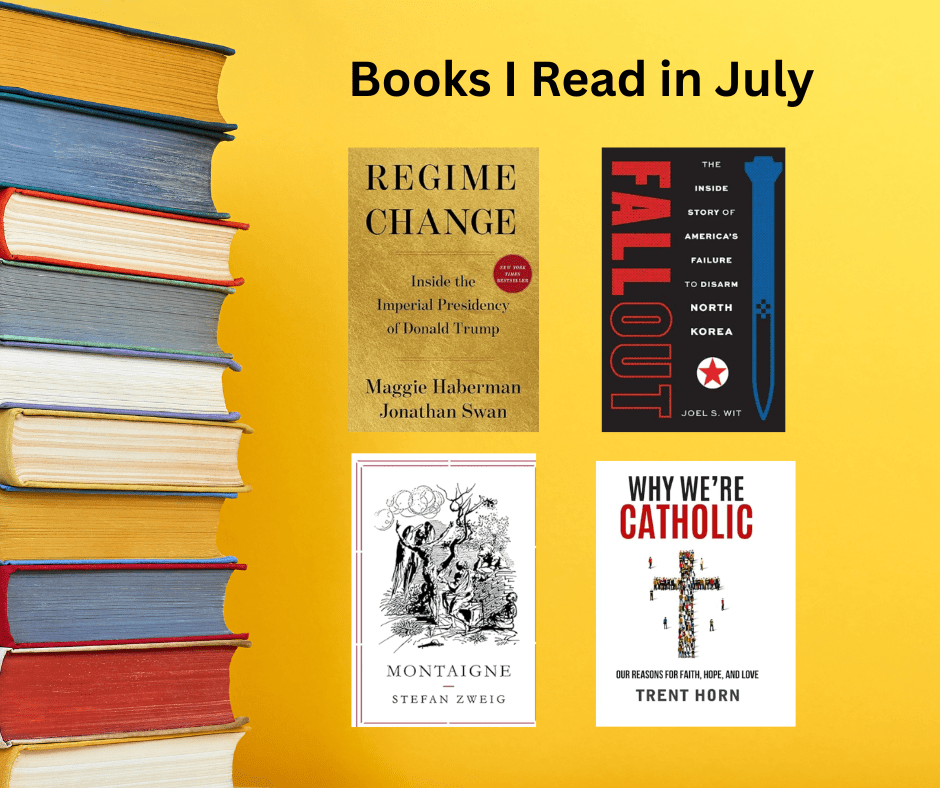
Given all of its hype, I couldn’t help but read “Regime Change – Inside the Imperial Presidency of Donald Trump” this month. It was a great insider’s look at the Trump White House. But I also read a couple of other thoughtful books not many have heard about.
NOTE: If you click on the title or book image, you can see the notes that I’ve taken on each book.

Regime Change – Inside the Imperial Presidency of Donald Trump
“Regime Change: Inside the Imperial Presidency of Donald Trump,” examines the President’s return to the White House and argues that his second term was built around far greater presidential power than his first. Authors Maggie Haberman and Jonathan Swan of the New York Times describe a leader who entered office with a clear plan, a loyal team, and fewer limits on his actions. They show how lessons learned after the 2020 election shaped new strategies for using executive authority, controlling the federal government, and rewarding loyal supporters while targeting political opponents. They also describe a White House where decisions often came directly from Trump, with little debate or normal review. Personal loyalty became the main test for those around him, while long-standing traditions and checks on presidential power received far less attention than in earlier administrations. MORE

Stefan Zweig and Will Stone
Stefan Zweig uses the life of Michel de Montaigne to show how one person can stay true to himself during violent and divided times. Zweig wrote the book while living in exile after fleeing Nazi rule, and he found deep comfort in Montaigne’s writings. Both men lived through periods filled with fear, hate, and political unrest. Rather than joining angry crowds or taking rigid sides, Montaigne turned inward to protect his freedom of thought and his sense of right and wrong. His essays became a record of honest self-study instead of fixed answers. He believed the best way to live was to question himself, learn from others, and avoid blind faith in any cause or leader. MORE

Fallout: The Inside Story of America’s Failure to Disarm North Korea
by Joel S. Wit
In his book, “Fallout: The Inside Story of America’s Failure to Disarm North Korea,” former US State Department official Joel Wit explains how North Korea changed from a country without nuclear weapons into one that can threaten the United States with long-range missiles. Despite many mistakes by recent US Presidents, he believes this outcome was not caused by one mistake or one president. It grew from years of missed chances, policy changes, political fights, and weak follow-through across several American administrations. The book shows how diplomacy often made progress before changing course, while pressure and sanctions alone failed to stop North Korea’s weapons program. It also describes how North Korean leaders viewed nuclear weapons as the best way to protect their rule, even while showing interest in better ties with the United States. MORE

Why We’re Catholic
“Why We’re Catholic: Our Reasons For Faith, Hope and Love,’ is an ideal book for someone who is questioning their faith or to share with someone who is considering Catholicism and doesn’t understand the principles of the Catholic Church. As a baptized Catholic and believer, I frankly didn’t learn much from this volume. Again, that’s not to say it isn’t valuable. Trent Horn answers questions many have. Understand that when you pick up this book. MORE
I’m frequently asked why I write out summaries of the books I read. I remember more when I take notes. This habit started when I was a journalist. Perhaps you might find them helpful. You can see a list of the books I’ve read in the last couple of years, along with links to my summaries, on my Book Notes page.

