
Book Summary
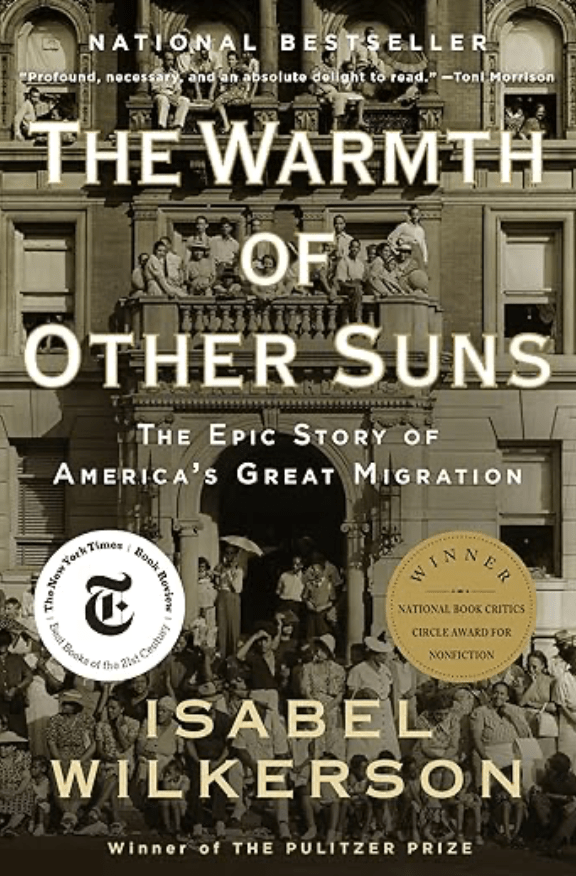
The Warmth of Other Suns: The Epic Story of America’s Great Migration
Isabel Wilkerson
2011 – Vintage – 640 pages
Dave’s Summary
The Warmth of Other Suns tells the story of the Great Migration through the lives of three Black Americans who left the South in search of freedom and dignity. Pulitzer-Price-winning author Isabel Wilkerson follows Ida Mae Gladney, George Starling, and Robert Foster as they escape harsh racism, unfair laws, and limited chances for a better life. Their stories show the fear, hope, and sacrifice shared by millions who moved north and west between 1915 and 1975. The book is a painful look at what these individuals (and countless others) faced in a period not distant from our own.
Ida Mae leaves Mississippi for Chicago after seeing how easily Black families could lose everything under Jim Crow rule. George flees Florida after labor protests place his life in danger. Robert Foster leaves Louisiana for California, hoping his medical skills will finally earn respect and fair treatment. Each person faces new struggles after arriving in their new city. Jobs, housing, and schools still carried deep racial bias. Yet they continued building lives for themselves and their families. Wilkerson explains how the migration reshaped American cities, politics, music, labor, and culture. She also challenges harmful myths about Black migrants by showing they were often hardworking, family-focused, and determined to succeed. The book presents the migration as one of the largest movements of people in American history. It changed both the South and the rest of the nation. At its heart, the story is about people risking everything for the simple right to live freely and pursue a better future.
Key Takeaways
- The Great Migration lasted about sixty years and moved millions of Black Americans out of the South. People left because daily life under Jim Crow laws denied safety, fairness, voting rights, and economic opportunity. Many risked their lives simply trying to board trains heading north or west. The movement reshaped major American cities and changed the nation’s social structure forever.
- Ida Mae, George Starling, and Robert Foster represent different paths taken during the migration. Ida Mae escaped sharecropping and racial terror in Mississippi. George fled Florida after standing up for fair wages and worker rights. Robert Foster sought respect as a doctor in California after facing limits in Louisiana. Their stories reveal both personal pain and quiet courage.
- Migrants often found new forms of racism outside the South. Northern and western cities offered more freedom, but housing bias, job limits, and school segregation still blocked progress. Black migrants were often blamed for urban problems even when evidence showed they were hardworking and stable family members. Many still managed to create strong communities despite these barriers.
- The migration deeply shaped American culture and public life. It changed politics, labor systems, education, and music across the country. Many later Black political leaders and major jazz artists came from migrant families. The movement also pushed the South toward civil rights reforms because so many workers and families had left.
- Wilkerson shows that the search for freedom drove the migration more than any single economic cause. People wanted basic human rights and control over their own lives. They wanted fair jobs, safe neighborhoods, decent schools, and respect. Even when life remained difficult after moving, many believed the chance to choose their future made the journey worth it.
Memorable Highlights
The Great Migration would not end until the 1970s, when the South began finally to change—the whites-only signs came down, the all-white schools opened up, and everyone could vote. By then nearly half of all black Americans—some forty-seven percent—would be living outside the South, compared to ten percent when the Migration began.
Over time, the story of the Great Migration has suffered distortions that have miscast an entire population. From the moment the emigrants set foot in the North and West, they were blamed for the troubles of the cities they fled to. They were said to have brought family dysfunction with them, to more likely be out-of-work, unwed parents, and on welfare, than the people already there. Closer analysis of newly available census records has found that, contrary to conventional thought, black migrants were actually more likely to be married and to raise their children in two-parent households, and less likely to bear children out of wedlock.
In 1896, in the seminal case of Plessy v. Ferguson, the Supreme Court sided with the South and ruled, in an eight-to-one vote, that “equal but separate” accommodations were constitutional. That ruling would stand for the next sixty years.
The South began acting in outright defiance of the Fourteenth Amendment of 1868, which granted the right to due process and equal protection to anyone born in the United States, and it ignored the Fifteenth Amendment of 1870, which guaranteed all men the right to vote.
If there was a single precipitating event that set off the Great Migration, it was World War I. After all, blacks had tried to escape the South with limited degrees of success from the time the first slaves arrived in Virginia in 1619. The Underground Railroad spirited hundreds of slaves out of the South and as far north as Canada before the Civil War.
But the masses did not pour out of the South until they had something to go to. They got their chance when the North began courting them, hard and in secret, in the face of southern hostility, during the labor crisis of World War I. Word had spread like wildfire that the North was finally “opening up.”
Purchase the book here and I will receive a small commission at no extra cost to you. But, by doing this, you help support my reading habit! Also, I do not get paid to read or review books. All of the books I summarize were either purchased by me or borrowed from my local library.

