Book Summary
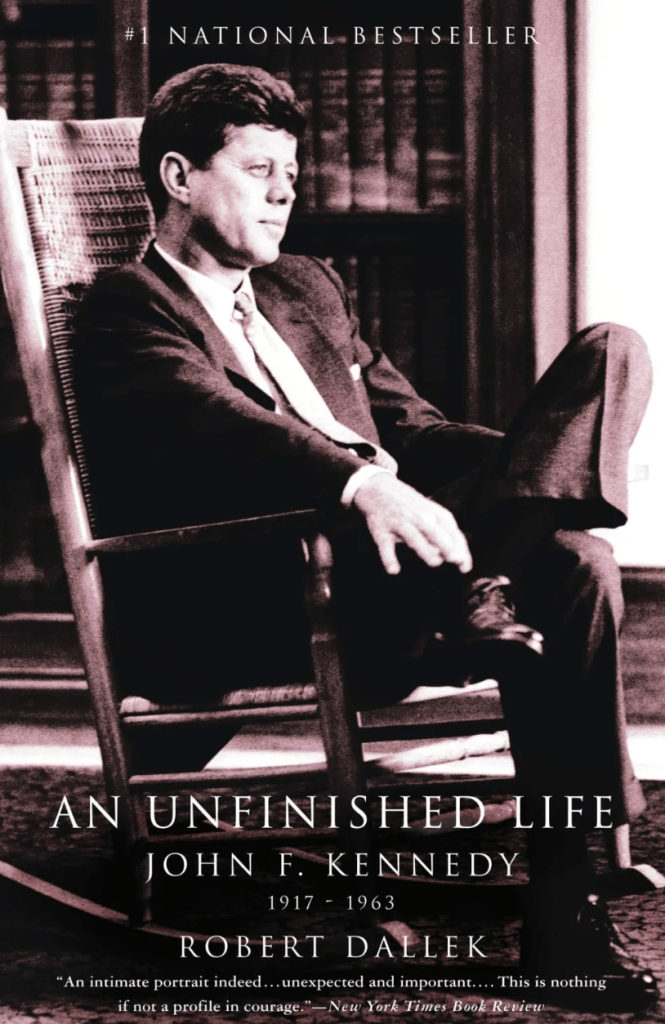
An Unfinished Life: John F. Kennedy, 1917-1963
by Robert Dallek
2004 – Little, Brown – 848 pages
Dave’s Summary
Historian Robert Dallek should be commissioned to write a book about every American president. “An Unfinished Life: John F. Kennedy” is one of the best books about the 35th president. He used information, including documents, Oval Office tapes, to share some information not previously known. For example, the documents share more details about the accident that killed Joseph Kennedy Jr in World War II, “how Bobby Kennedy became attorney general in 1960, and what JFK thought of U.S. military chiefs, their plans for an invasion of Cuba, the American press corps in Saigon, and the wisdom of an expanded war in Vietnam.
Kennedy, we know, grew up in a wealthy and driven family that prized success and image. His father pushed his children toward public life and expected strong results. As a young man, Kennedy wasn’t the strongest student, but he showed a curiosity about world events. Time in Europe and his studies at Harvard shaped his views on global power and conflict. His early writing stressed clear thinking and realism when dealing with foreign threats.
He lived with serious health problems from a young age, including pain, illness, and long hospital stays. He often hid these issues, which added strain but also built inner strength. His war service became a turning point when he showed courage after his boat was destroyed and helped save his crew. Family loss, including the death of his brother, changed his path and pushed him toward politics. He entered public life with strong family backing and won early races through effort and careful planning.
In Congress and the Senate, Kennedy built a reputation as thoughtful but still learning. He focused on foreign policy and national security while balancing a busy social life. His personal behavior often clashed with his public image, yet it remained mostly hidden. His campaign for president faced doubts about his youth, faith, and health. He used television and direct messaging to connect with voters and win support in a close race.
As president, Kennedy dealt with intense global pressure during the Cold War. Early in his term, the failed Cuba invasion exposed poor planning and weak advice. He took responsibility and adjusted how he made decisions. He relied less on blind trust and more on careful review. He chose a flexible approach to military action, aiming to avoid nuclear war while still showing strength.
He faced ongoing challenges in places like Vietnam, Laos, and Cuba. He often resisted calls for full military action, even when pressure grew. At home, he moved slowly on civil rights, weighing political risks against moral duty. He also pushed programs like the Peace Corps to build goodwill abroad. His leadership style blended caution with resolve, shaped by past mistakes and constant global tension.
Kennedy’s life showed a mix of ambition, discipline, and personal struggle. He worked to balance public duty with private flaws and health limits. His presidency was cut short, leaving open questions about what he might have achieved. His legacy rests on how he handled crisis, inspired public support, and guided the nation through a dangerous time.
Key Takeaways
- Kennedy’s early life mixed privilege with pressure. His father demanded success and shaped his path, while family issues and hidden struggles influenced his character and drive.
- His health problems were severe and constant, yet he concealed them from the public. These challenges built toughness but also created risks that followed him into office.
- His war experience became a key part of his public image. His actions during the PT boat crisis showed courage and helped launch his political career.
- Kennedy’s rise in politics relied on family support, personal charm, and smart strategy. He learned quickly and built a strong national presence through media and public appeal.
- As president, he faced major global threats and chose careful, flexible actions. Early mistakes shaped better decisions, helping him avoid larger conflicts and manage Cold War tensions.
Memorable Highlights
But a life without ambition, without some larger purpose than one’s own needs and satisfaction, was never part of the Kennedy ethos. It is one of the great ironies of this family’s saga that however frivolous any of its members might be at one time or another, it was impermissible to make frivolity a way of life.
Jacqueline Bouvier Kennedy told the journalist Theodore White that “history made him [Jack] what he was… this lonely sick boy. His mother really didn’t love him…. She likes to go around talking about being the daughter of the Mayor of Boston, or how she was an ambassador’s wife…. She didn’t love him…. History made him what he was.”
Any number of things explain Kennedy’s victory: the faltering economy in an election year; anxiety about the nation’s apparently diminished capacity to meet the Soviet threat; Kennedy’s decidedly greater personal charm alongside Nixon’s abrasiveness before the TV cameras and on the stump; Lyndon Johnson’s help in winning seven southern states (Alabama, Arkansas, Georgia, Louisiana, North Carolina, South Carolina, and Texas); an effective get-out-the-vote campaign among Democrats, who, despite Eisenhower’s two elections, remained the majority party; the black vote for Kennedy; and the backing of ethnic voters, including but much broader than just Catholics, in big cities like New York, Buffalo, Chicago, Newark, Philadelphia, and Pittsburgh. Kennedy’s margins in Detroit, Minneapolis–Saint Paul, and Kansas City helped give him 50.9, 50.6, and 50.3 percent majorities in Michigan, Minnesota, and Missouri, respectively. Contributing to Kennedy’s win was an unwise Nixon promise to visit all fifty states, which had diverted him from concentrating on crucial swing areas toward the end of the campaign. Ike’s blunder in dismissing Nixon’s claims of executive leadership and his failure, because of health concerns, to take a larger role in his vice president’s campaign may also have been decisive factors in holding down Nixon’s late surge.
Forty-three years after the election of 1960, it is difficult to imagine the importance of something that no longer seems significant in discussions about suitability for the White House. Whatever gains and losses John Kennedy’s presidency might have brought to the country and the world, his election in 1960 marked a great leap forward in religious tolerance that has served the nation well ever since.
His management of one international crisis after another to avert what he described as “the ultimate failure” was the greatest overall achievement of his presidency.
Biographers have speculated on whether Kennedy’s medical treatments, including daily cortisone for Addison’s and back injections, affected his performance as president. Previously secret medical records gathered by Janet Travell give us a more authoritative answer to the question. During the first six months of his presidency, stomach/colon and prostate problems, high fevers, occasional dehydration, abscesses, sleeplessness, and high cholesterol accompanied Kennedy’s back and adrenal ailments. Medical attention was a fixed part of his routine. His physicians administered large doses of so many drugs that they kept an ongoing “Medicine Administration Record” (MAR), cataloging injected and oral corticosteroids for his adrenal insufficiency; procaine shots to painful “trigger points,” ultrasound treatments, and hot packs for his back; Lomotil, Metamucil, paregoric, Phenobarbital, testosterone, and Transentine to control his diarrhea, abdominal discomfort, and weight loss; penicillin and other antibiotics for his urinary infections and abscesses; and Tuinal to help him sleep. Though the treatments occasionally made him feel groggy and tired, Kennedy did not see them as a problem.
At the NSC meeting on the fifteenth, Kennedy “expressed the fear of becoming involved simultaneously on two fronts on opposite sides of the world. He questioned the wisdom of involvement in Viet Nam since the basis thereof is not completely clear.” Comparing the war in Korea with the conflict in Vietnam, he saw the first as a case of clear aggression and the latter as “more obscure and less flagrant.” He believed that any unilateral commitment on the part of the United States would produce “sharp domestic partisan criticism as well as strong objections from other nations.” By contrast with Berlin, Vietnam seemed like an obscure cause that “could even make leading Democrats wary of proposed activities in the Far East.”
For all of Kennedy’s reluctance, international and domestic pressures persuaded him to commit new U.S. resources to Vietnam. Everything he said about Vietnam during the first ten months in office made clear that he doubted the wisdom of expanded involvements in the fighting. But after the defeat at the Bay of Pigs, Khrushchev’s uncompromising rhetoric in Vienna, the refusal to fight in Laos, construction of the Berlin Wall, and Soviet resumption of nuclear tests, Kennedy believed that allowing Vietnam to collapse was too politically injurious to America’s international standing and too likely to provoke destructive domestic opposition like that over China after Chiang’s defeat in 1949.
His restraint in resisting a military solution that would almost certainly have triggered a nuclear exchange makes him a model of wise statesmanship in a dire situation. One need only compare his performance with that of Europe’s heads of government before World War I—a disaster that cost millions of lives and wasted unprecedented sums of wealth—to understand how important effective leadership can be in times of international strife. October 1962 was not only Kennedy’s finest hour in the White House; it was also an imperishable example of how one man prevented a catastrophe that may yet afflict the world.
Kennedy’s death shocked the country more than any other event since the December 1941 attack on Pearl Harbor. The assassination produced an outpouring of grief that exceeded that felt by Americans over the killings of Lincoln, James A. Garfield, and William McKinley, or over FDR’s sudden death in April 1945. However traumatic Lincoln’s assassination, the four years of Civil War bloodletting, which took 620,000 lives, somewhat muted the horror of losing the nation’s leader. It was as if Lincoln’s demise was foreordained—the culmination of a four-year catastrophe that tested the nation’s capacity to survive.
The sudden end to Kennedy’s life and presidency has left us with tantalizing “might have been’s.” Yet even setting these aside and acknowledging some missed opportunities and false steps, it must be acknowledged that the Kennedy thousand days spoke to the country’s better angels, inspired visions of a less divisive nation and world, and demonstrated that America was still the last best hope of mankind.
Purchase the book here and I will receive a small commission at no extra cost to you. But, by doing this, you help support my reading habit! Also, I do not get paid to read or review books. All of the books I summarize were either purchased by me or borrowed from my local library.
 Dave Edwards Media