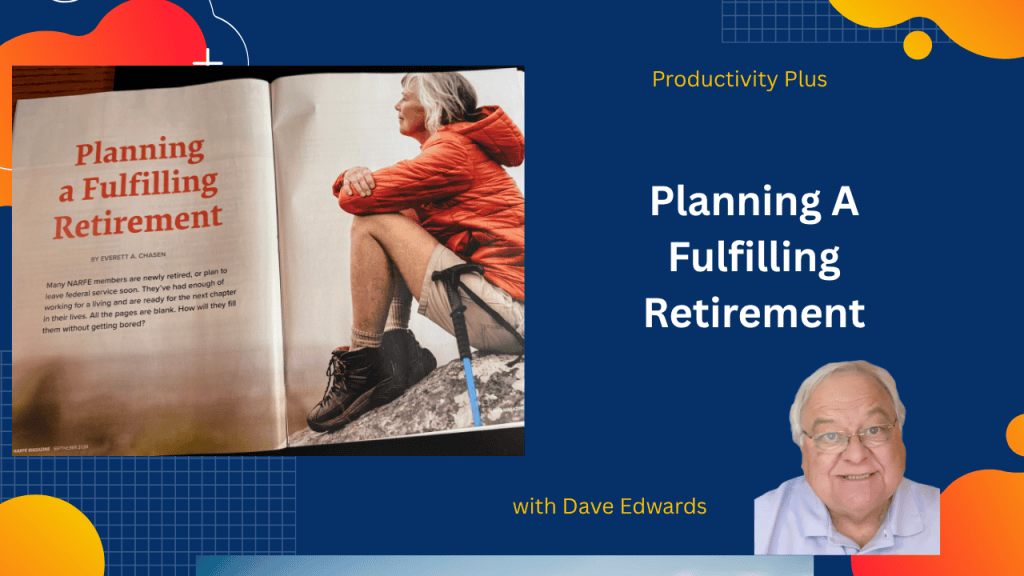
One of my followers, Everett Chasen, interviewed me for an article he was writing for NARFE magazine, a publication for federal employees and retirees. I thought you might be interested:
Planning a Fulfilling Retirement
BY EVERETT A. CHASEN
Many NARFE members are newly retired, or plan to leave federal service soon. They’ve had enough of working for a living and are ready for the next chapter in their lives. All the pages are blank. How will they fill them without getting bored?
According to Dave Edwards, a retiree who is now a consultant on productivity, leadership, and management issues (www. DaveEdwardsMedia.com), the key is to remain productive, but in a different way than when you were working. For retirees, productivity ensures the time you have is spent on the things that matter most to you.
“I view productivity in a very simple way,” he said. “It’s getting things done that are important to you in such a way that you know those things have the right kind of value in your life. They don’t have to be all-consuming, but it feels good when you get stuff done.”
For retirees, being productive is different than if you work in a nine to five job.
“There, you have a boss who gives you tasks and they have to be done by Wednesday,” Edwards added. “But when you’re retired, what is Wednesday? And whether you do something on Wednesday or Friday doesn’t make a whole lot of difference.”
The problem is that some people lose track of time and don’t meet deadlines and find themselves being unproductive.
“They don’t do anything,” he said. “They get up in the morning. They watch TV or they’re on their phone. It’s about finding a balance.”
Finding a balance between chores, projects, hobbies, social time, travel, and even afternoon naps is different for everyone. While some retirees are content to accomplish only a small amount in a day, others are very active. They volunteer at organizations, have hobbies or side jobs, exercise
and travel regularly, or do all of those things at different times.
“It’s a matter of finding your own happiness,” said Edwards.
Structuring Your Days
However much or little you want to accomplish when you retire, you need to build a structure for your days, weeks, even seasons of the year. Jobs provide schedules, tasks, and accountabilities, but retirement removes that built-in structure. For some people, that creates a sudden void.
“The problem is that some people lose track of time and don’t meet deadlines and find themselves being unproductive. They don’t do anything: they get up in the morning, they watch TV, or they’re on their phone. It’s about finding a balance.”
–Dave Edwards, retiree and consultant
“You want to have some kind of structure so you don’t drift into doing things that aren’t going to give
you great satisfaction,” said Edwards. Beginning to create a structure involves creating
bookends. Have a consistent wake-up and bedtime schedule.
“That might be 8:30 in the morning, or six a.m.,” he noted. “Then adjust your sleep time accordingly.” Next, find “anchors” for your days. “Think about what you’re going to do in the course of the day,” said Edwards. “You’re going to eat, right? You might have hobbies or social activities that are important to you. Treat your calendar like a retirement road map, and ask yourself when you want your day to start and finish and what activities will bring rhythm and variety to your schedule.” Consider changing your focus every quarter, especially if you live somewhere the seasons change significantly. Winter can be a time for learning and reading. Spring is a good time for gardening and household repairs. Plan travel and other outdoor activities in summer, and fall can be perfect for planning, reflection and family events. Think about what is important to you in each quarter, and then build out your weeks and months accordingly. Don’t overschedule yourself, though. “Retirement shouldn’t feel like another job,” Edwards warned.
The value of exercise
It’s important, Edwards believes, to make exercise a priority.
“That’s how you stay healthy,” he said. “You have to have that built into part of your life. If you don’t move, if you don’t get any exercise, medical research tells us that will accelerate aging and declining health. You might choose walking, cycling, gardening, yoga or whatever you want to do—and it doesn’t have to be strenuous.”
Edwards and his wife like to walk together. “We’re out there walking, not only because it keeps our heart rate up, but it also gets us outside in the fresh air,” he added.
They also own a treadmill because it can get quite icy during Wisconsin winters.
Karen Scheer, a retired teacher, takes walking a step further.
“In my 20s,” she says, “I lived in Atlanta. To escape the heat of the city, I would camp out in the mountains of North Georgia and hike part of the Appalachian Trail.”
Later, she and her family took many vacations that included hiking together.
Today, Scheer still enjoys hiking because “I love to be outdoors. I don’t think of hiking as a physical activity like running. To me, it’s just being out with nature and having a start and a finish to the activity.”
Scheer prefers short hikes to longer ones. “Sometimes, I hike by myself, but I try to hike in groups
because I’m older now, and if I fall or something, I’d rather be in a group,” she adds. “If something goes wrong, there’s other people around, and if there’s a medical emergency, the leader can take care of it.” Scheer recently hiked around places like Joshua Tree, California; Mexico; and Harper’s Ferry, West Virginia. She finds new hikes on the Trip Advisor website and with the Road Scholars organization (www.roadscholar.org). Other organizers of senior hikes include ElderTreks, Overseas Adventure Travel, Gate 1 Travel, Walking the World, and Adventures in Good Company (for women over 60). There are other ways to get regular exercise: joining a gym, for example, or purchasing fitness equipment to use at home. Many federal retirees have health plans that allow them to join local gyms or take part in at-home classes for free. These offer safe and fun ways to work out and maintain the flexibility, mobility, strength, balance, and cardiovascular health seniors need to get and stay active.
Structure In Practice
Edwards described how his own days are structured.
“Two of our grandchildren live very close to us, so we wake up early because their mom drops them off at our house, and we get them fed and ready for school,” he said. “I take them to school in the morning and pick them up in the afternoon.”
Edwards also has a consulting practice where he works with people on productivity, leadership, and management issues.
“So, I’m doing Zoom calls with them,” he said. “I’m writing and producing videos for YouTube, and volunteering at my granddaughters’ school and at our church pantry. Also, I teach part-time for a local university.”
Every one of those things is something Edwards chooses to do, and finds great joy in doing.
“I still have time to read and go for walks with my wife,” he added. “I also feel I’ve got to do all of this while I have my health. No one is guaranteed tomorrow, and no one is guaranteed good health. So, while I’m blessed with the ability to enjoy all those things, I want to get the most out of life. If I try something and it doesn’t meet my needs, or I don’t feel I’m being terribly helpful, I don’t want to do it.”
Traveling and Volunteering
There are, of course, other activities important to retirees that don’t fit neatly into an everyday schedule. One of those is travel.
Travel doesn’t have to mean buying a plane ticket and traveling to Europe. It can be as simple as hopping a train for a short distance, or getting in the car and going for a ride.
“You don’t even have to pack a bag,” said Edwards. “Just head in a direction, and you’ll be surprised at what you see. Don’t stop at a fast food restaurant for lunch. Instead, stop at a mom-and-pop place. That’s what we find. We live just outside of Milwaukee, and in the same distance that it would take us to get to the city, we can be out in farm fields and communities.”
On the other hand, Edwards recently decided to go down to the lakefront along Lake Michigan, and ended up in downtown Milwaukee.
“We went to the art center, and had lunch in a public market. We hadn’t done that in a long time, and it was just great!”
Many federal retirees find volunteer work to be a fulfilling use of their time. Some volunteer for the agencies they worked for before retirement; others look for opportunities to develop new skills.
“I volunteer to do things I really enjoy doing,” said Edwards. “There have been things people suggested I could try as a volunteer, and they just don’t sound interesting, or they sound too much like
the work I used to do before I retired. I help out at my granddaughter’s school. She’s in first grade and I
help her and her classmates with their reading. And I get such joy out of it, not only because I get to work with my granddaughter, but all the other kids are so cute and cool and funny.”
Edwards also helps out at his church’s food pantry. “I’m hoping the person on the other side is
benefiting from my help—but sometimes I think I benefit more than they do!”
Finding a Hobby
Hobbies are another option for retirees looking for anchors for their days and weeks. Edwards is a gardener.
“In winter, I do the bulk of my writing and consulting, and that’s when I teach,” he said. “Once spring and summer come, I’m much more focused on external things. I’m outside a lot more. I love to garden. That’s part of the seasonality of what I like to do.”
Music is another popular hobby for many retirees—some of whom never played an instrument before retirement. Recent retiree Peter Johnson played the piano as a child and continued to play for his own enjoyment throughout his working life. His dad, an amateur musician, owned an accordion, and Johnson played that instrument “only a few times” before he retired.
Shortly after he retired, he had an opportunity to play the piano for a Christmas party sing-along with his fellow retirees. On a lark, he took his dad’s accordion to the party and used it for just one song. Also entertaining at the party was a group from a local community-based orchestra that included the accordion in its instrumentation.
“When they heard me play, they encouraged me to join the group,” said Johnson. “I was shocked. But I got up my nerve, went to a rehearsal, bought a new accordion, and the rest is history.”
Now, Johnson is president of a local accordion society, and performs solo and with singers and small ensembles at parties and celebrations. He’s written several original compositions, three of which have won awards, and can play hundreds of songs by ear.
“It’s good for the brain and the soul, and a great way to meet people,” he said. “It feels good to be able to grow in an area that is meaningful to you. Music brings people together, and it’s very satisfying to know I can do that even at my intermediate level of playing. You just have to be good enough to know that people can appreciate what you’re doing and get pleasure from it.
Pay Attention to Your Finances
Finally, you have to consider your financial situation.
“I think sometimes people don’t give that as much serious thought as they should,” said Edwards.
“About 10 years before I was going to retire, I started meeting regularly with a financial planner, so I could be sure I was going to be financially okay when I retired,” he added. “I’m fortunate I have a pension, and that was part of the equation. But I also had a good financial plan going into my retirement years, and I made sure I had good health insurance. Those are the most important things you need.”
Also, homeowners should check on their home insurance to ensure that their home is protected like the important financial asset it is—and if they downsize to a condominium, they should make sure their new insurance is well-integrated with the insurance carried by their condo association
“If you don’t have financial security, none of the rest of this matters,” Edwards explained.
Closing Thoughts
The most important question a new retiree or someone who plans to retire soon should ask themselves, Edwards said, is this: how do I want to spend my time, and what will bring me fulfillment?
“My wife retired shortly before I did, She said to me, you’re going to have to deal with the feeling you’re no longer relevant. I think when we’re in the workday world, we define relevance by the services we provide to our employer and the way we’re viewed by our employer and our peers.”
“In retirement, I kind of changed that approach. How do I feel relevant now? By doing things, helping, learning, and staying active.”
“I’m not an expert on this subject,” he concluded modestly. “I’m just living it. I’m modifying my outlook on life every day!”
—EVERETT A. CHASEN IS A FREELANCE REPORTER BASED IN THE GREATER WASHINGTON, D.C. AREA.

