Book Notes
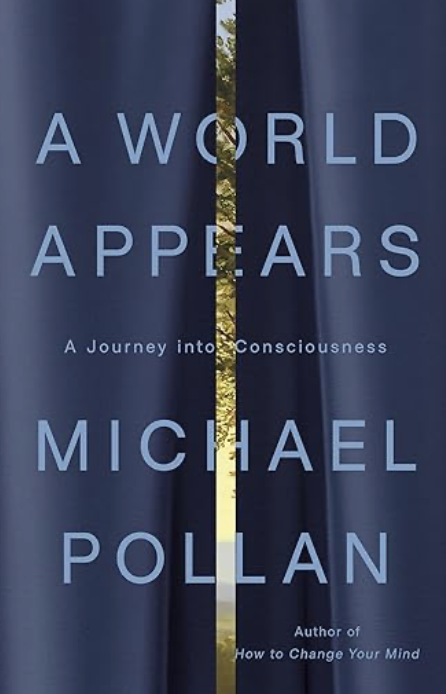
A World Appears: A Journey into Consciousness
Michael Pollan
2026 – Penguin – 318 pages
Dave’s Notes
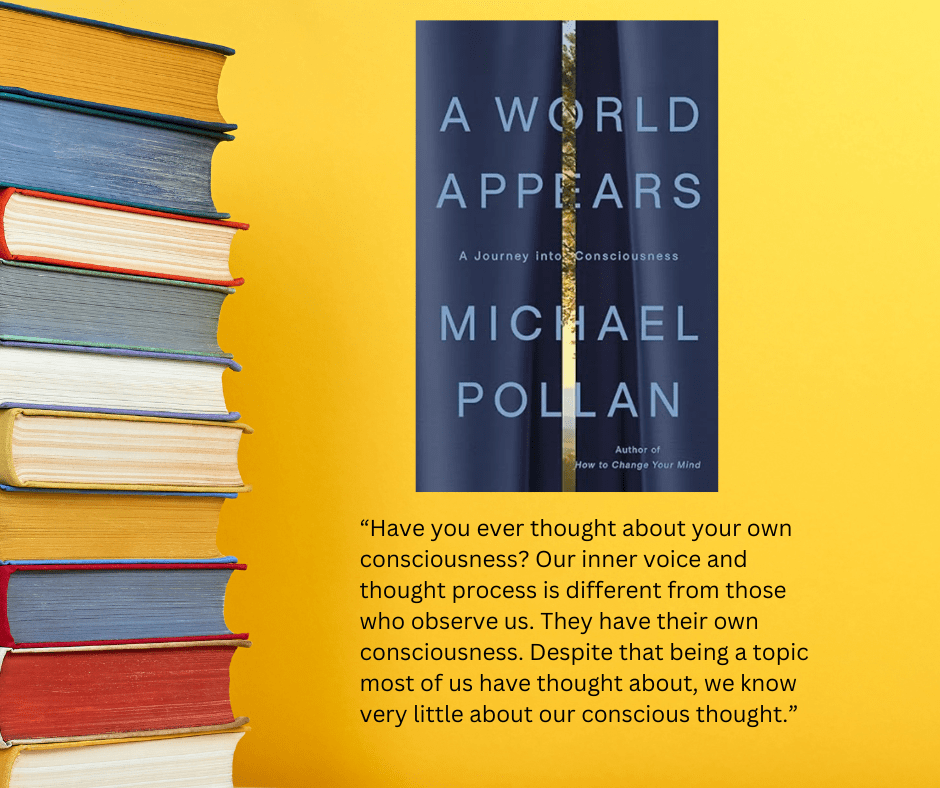
Have you ever thought about your own consciousness? Our inner voice and thought process is different from those who observe us. They have their own consciousness. Despite that being a topic most of us have thought about, we know very little about our conscious thought.
People understand the brain’s physical parts, yet awareness remains unclear. In A World Appears, Michael Pollan studies the issue. He does not pretend to have all the answers. Instead, he guides readers through major theories about the mind and human awareness.
Many researchers believe consciousness grows from brain activity alone. The brain contains billions of nerve cells that constantly exchange signals. Changes to the brain can quickly affect memory, emotion, and perception. That connection supports a physical explanation of awareness. Even so, scientists still cannot explain how brain matter creates feelings, thoughts, and personal experience. A computer may process information, yet processing alone does not explain self-awareness.
Pollan also examines theories that move beyond strict material science. One idea claims that tiny forms of awareness exist throughout nature. Another suggests consciousness exists apart from the brain, while the brain simply connects to it. These ideas may sound strange, but Pollan treats them seriously while remaining skeptical. He asks readers to think openly without accepting the claims.
The subject feels more urgent because artificial intelligence keeps improving. Machines can now imitate speech, reasoning, and human conversation with surprising skill. That progress raises moral questions about future technology. If machines ever become truly aware, society may face new duties and risks. Pollan’s book reminds us that consciousness remains one of the hardest puzzles in science.
Memorable Highlights
According to Integrated Information Theory, every such moment of consciousness shares the same five specific qualities: It is “intrinsic” (that is, it has an internal perspective); it is “composed” of many distinct phenomenal parts (think of the way the experience combines elements of perception, memory, feeling, imagination, etc.); it is “integrated,” or unified (these elements are joined together in a single experience at a time); it is “definitive” (it is this and not that, in other words); and it is “bounded” (it has an edge beyond which the conscious perception doesn’t go). I won’t wade into all the details, but the theory holds that in order for a physical system to generate these experiential qualities, it must exhibit a certain kind of (massive) interconnectivity and recursiveness, whether among neurons or among other similarly networked things (such as transistors on a silicon chip). It’s important to note that IIT does not restrict consciousness to brains. Any physical system properly configured to integrate information is, to some degree or another, theoretically conscious.
The theory asks us to imagine the mind as a theater, mostly dark except for the spotlit stage—that’s the workspace, washed in the light of attention. Information that makes it “onstage” gets “broadcast” to the entire brain, at which point it pops into consciousness. The value of this information becoming conscious is that it can be used to guide behavior more flexibly than automatic processing would. Consciousness creates a space for decision-making.
One reason why consciousness has proved such a hard nut for science and philosophy is because the only tool we can use to crack it is consciousness itself.
It doesn’t help that scientists and philosophers who work on the problem don’t agree on what they mean by the word consciousness or on what, exactly, they are trying to explain. For some, it is the basic fact of perception—that a world appears when we open our eyes. For others, it is that we can reflect on ourselves, as in a mirror. Some think of consciousness as a lens through which we perceive the world, while others take the same word to mean the space of interiority in which thinking and feeling seem to happen.
Sentience is where consciousness begins: with the ability of living beings to register sensations and respond intelligently.
And then there is cognition, which, like intelligence, does not depend on consciousness but is related to it. Cognition involves the acquisition and processing of information about the state of one’s environment and self. Think of it as what happens between sensing and responding.
Purchase the book here and I will receive a small commission at no extra cost to you. But, by doing this, you help support my reading habit! Also, I do not get paid to read or review books. All of the books I summarize were either purchased by me or borrowed from my local library.