Book Notes
The Organized Mind
Daniel Levitin
2015 – Sutton – 544 pages
Dave’s Summary
In The Organized Mind, Daniel Levitin says your brain has limits. It can only handle so much at once.
Today you face more input than ever before. In 2011, Americans took in five times more data than in 1986. That equals about 175 newspapers a day. Your brain can process it, but you pay a price. You get tired. You struggle to tell what matters.
Levitin explains two attention modes. One is central executive mode. It helps you focus on a task. The other is mind-wandering mode. It kicks in when you relax. You can’t truly multitask. You just switch back and forth. That constant shift drains you.
Memory works through links. One thought sparks another. Each time you recall something, you rewrite it a bit. Memory feels solid, but it bends and shifts. Strong emotion helps you remember. It does not make the memory exact.
Sleep plays a key role. It helps lock in new learning. During sleep, your brain joins ideas, runs mental tests, and pulls out rules. Without sleep, memories stay weak. I’ve seen this in my own work. A good night’s sleep clears my thinking.
Levitin says there is a simple fix. Sort and store outside your head. Write things down. Group items by type or use. When you offload tasks to paper, your brain relaxes. It stops trying to hold everything.
Our ancestors wrote things down to extend memory. You can do the same. A to-do list frees mental space. A tidy desk cuts stress. When you know where things are, you save time and energy.
He also notes we often “satisfice,” a term from Herbert Simon. That means you pick an option that is good enough. You don’t chase the perfect choice. Happy people focus on what they have, not what they lack.
The book shows you how to work with your brain, not against it. You can’t expand its raw capacity. But you can build systems that support it. When you sort your thoughts and space, you make better choices. You feel calmer. And you free your mind for creative work.
Takeaways
- Your brain has limits. It can only process so much at once.
- Modern life floods you with input. Too much choice drains energy.
- You can’t truly multitask. You switch tasks and lose focus each time.
- You have two attention modes. Focus mode and mind-wandering mode both matter.
- Memory is not a replay. Each recall rewrites the event.
- Emotion helps you remember. It does not make memories exact.
- Sleep locks in learning. It links ideas and pulls out hidden rules.
- Write things down. Offload tasks so your brain can relax.
- Sort items into clear groups. Simple systems save time and stress.
Memorable Highlights
Neuroscientists have recently discovered that parts of the brain can fall asleep for a few moments or longer without our realizing it. At any given moment, some circuits in the brain may be off-line, slumbering, recouping, energy, and as long as we’re not calling on them to do something for us, we don’t know.
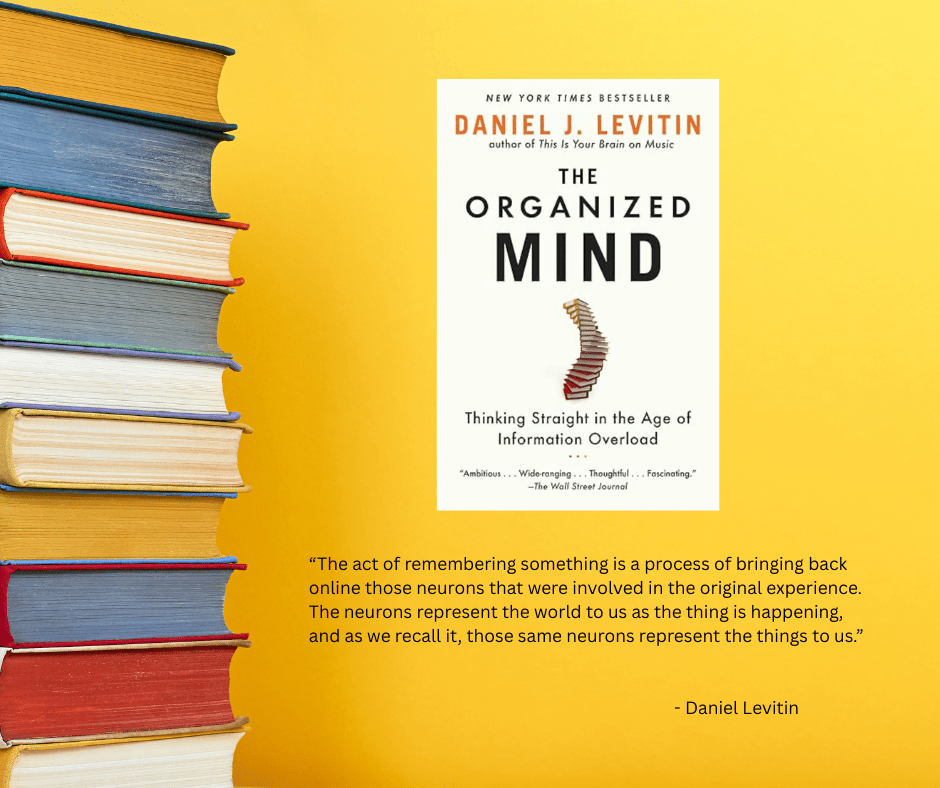
The act of remembering something is a process of bringing back online those neurons that were involved in the original experience. The neurons represent the world to us as the thing is happening, and as we recall it, those same neurons represent the things to us.
But remembering is imperfect. The instructions for which neurons need to be gathered and how exactly they need to fire a weak and degraded. That leads to representation that is only a dim and often an inaccurate copy of the real experience. Memory is fiction. It may present itself to us as fact, but it is highly susceptible to distortion. Memory is not just a replay, but a rewriting.
Events or experiences that are out of the ordinary tend to be remembered better because there is nothing competing with them when your brain tries to access them from its storehouse of remembered events.
We need to spend roughly 1/3 of our time sleeping in order to function properly. But without cues from the sun, our bodies will drift toward a 25 hour day. We don’t know why this is so.
As people grow older, they frequently say that time seems to pass more quickly than when they were younger. There are several hypotheses about this. One is that our perception of time is non-linear and is based on the amount of time we’ve already lived. A year in the life of a four-year-old represents a large larger portion of the time she’s already been alive than it does for a 40-year-old. Another factor is that after the age of 30 our reaction time, cognitive processing speed, and metabolic rate slowed down. The actual speed of neural transmission slows. This leaves the impression that the world is racing by relative to our slowed down thought process.
Purchase the book here and I will receive a small commission at no extra cost to you. But, by doing this, you help support my reading habit! Also, I do not get paid to read or review books. All of the books I summarize were either purchased by me or borrowed from my local library.
 Dave Edwards Media