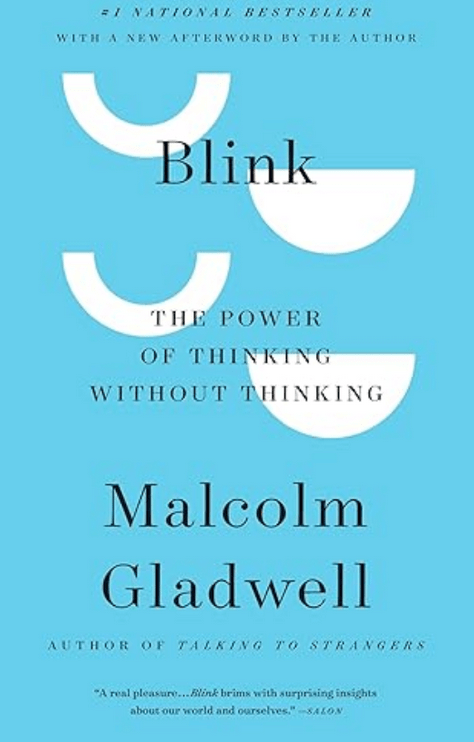
Blink : The Power of Thinking Without Thinking
by Malcolm Gladwell
2007 – Back Bay Books – 296 pages
Dave’s Summary:
Malcolm Gladwell combines unique stories to make a point. In his book, “Blink” he looks at rapid cognition—the ability of our subconscious minds to make quick and often accurate decisions. He believes both the power and the pitfalls of snap judgments can be both beneficial and misleading. He writes that the trick is to achieve a balance between intuitive and conscious thinking so it can significantly improve our decision-making.
As typical of all of his books, Gladwell uses stories and studies to explain his ideas. For example, researchers who listen to a couple speak briefly can predict the likelihood of their marriage surviving. This demonstrates the power of “thin-slicing,” making insightful decisions based on minimal information. He discusses how we often make snap judgments and rationalize them later, showing how our unconscious associations influence our behavior.
Gladwell also points out that our instincts are not infallible. Stress and high-pressure situations can lead us to faulty decisions by impairing our adaptive unconscious, making us temporarily “autistic” in the sense that we lose our ability to read social cues. He argues that successful decision-making requires understanding when to trust our instincts and when to be cautious. Gladwell highlights the idea of “verbal overshadowing,” where attempts to verbalize visual information can undermine our natural abilities, as seen in recognizing a face.
He also discusses how our unconscious biases affect our thinking. These biases may conflict with our conscious values, and Gladwell suggests that actively experiencing new things is essential for overcoming prejudices. He underscores the importance of editing the amount of information considered during decision-making, warning that too much detail can obscure the vital data needed for practical judgment.
Ultimately, Gladwell shows that rapid cognition is a powerful tool. Still, to harness it fully, we must learn to recognize the subtle influences that shape our thinking and balance instinct with deliberation.
Five Takeaways:
1. The Adaptive Unconscious: The adaptive unconscious is like a sophisticated computer operating in the background, enabling rapid decision-making without conscious thought. This concept is crucial in understanding how we make quick, effective decisions.
2. Thin-Slicing: Thin-slicing refers to the ability to conclude from minimal information. Gladwell illustrates this concept with the example of researchers predicting the success of a marriage based on just a few minutes of conversation.
3. Verbal Overshadowing: Verbal overshadowing shows that our ability to recognize faces, an intuitive and visual skill, can be impaired by attempting to describe them verbally. This phenomenon highlights how different brain parts may interfere with each other during cognitive processes.
4. Implicit Associations and Bias: Our unconscious attitudes may contradict our conscious beliefs, affecting our decision-making and interactions. Understanding and overcoming these implicit biases requires actively exposing ourselves to new experiences.
5. Stress and Decision-Making: The adaptive unconscious can fail under stress, leading to poor judgments. Gladwell uses the analogy of temporarily becoming autistic to describe how stress limits our ability to read nonverbal cues and social situations accurately.
The premise of “Blink” is that while snap judgments and first impressions can be incredibly powerful, they must be cautiously approached. Truly effective decision-making requires balancing instinctive thinking with deliberate analysis, recognizing when our unconscious insights are valuable and when they might be misleading.
Memorable Highlights:
Let me give you a very simple example of this. Picture, in your mind, the face of the waiter or waitress who served you the last time you ate at a restaurant, or the person who sat next to you on the bus today. Any stranger whom you’ve seen recently will do. Now, if I were to ask you to pick that person out of a police lineup, could you do it? I suspect you could. Recognizing someone’s face is a classic example of unconscious cognition. We don’t have to think about it. Faces just pop into our minds. But suppose I were to ask you to take a pen and paper and write down in as much detail as you can what your person looks like. Describe her face. What color was her hair? What was she wearing? Was she wearing any jewelry? Believe it or not, you will now do a lot worse at picking that face out of a lineup. This is because the act of describing a face has the effect of impairing your otherwise effortless ability to subsequently recognize that face. The psychologist Jonathan W. Schooler, who pioneered research on this effect, calls it verbal overshadowing. Your brain has a part (the left hemisphere) that thinks in words, and a part (the right hemisphere) that thinks in pictures, and what happened when you described that face in words was that your actual visual memory.
It is hard for us to explain our feelings about unfamiliar things.
The problem with market research is that often it is simply too blunt an instrument to pick up this distinction between the bad and the merely different.
That same year, CBS was also considering a new comedy show starring Mary Tyler Moore. It, too, was a departure for television. The main character, Mary Richards, was a young, single woman who was interested not in starting a family — as practically every previous television heroine had been — but in advancing her career. CBS ran the first show through the Program Analyzer. The results were devastating. Mary was a “loser.” Her neighbor Rhoda Morgenstern was “too abrasive,” and another of the major female characters on the show, Phyllis Lindstrom, was seen as “not believable.” The only reason The Mary Tyler Moore Show survived was that by the time CBS tested it, it was already scheduled for broadcast. “Had The MTM been a mere pilot, such overwhelmingly negative comments would have buried it,” Sally Bedell [Smith] writes in her biography of Silverman, Up the Tube.
An officer with a partner is no safer than an officer on his own. Just as important, two-officer teams are more likely to have complaints filed against them. With two officers, encounters with citizens are far more likely to end in an arrest or an injury to whomever they are arresting or a charge of assaulting a police officer. Why? Because when police officers are by themselves, they slow things down, and when they are with someone else, they speed things up.
Purchase the book here and I will receive a small commission at no extra cost to you. But, by doing this, you help support my reading habit! Thanks.
 Dave Edwards Media