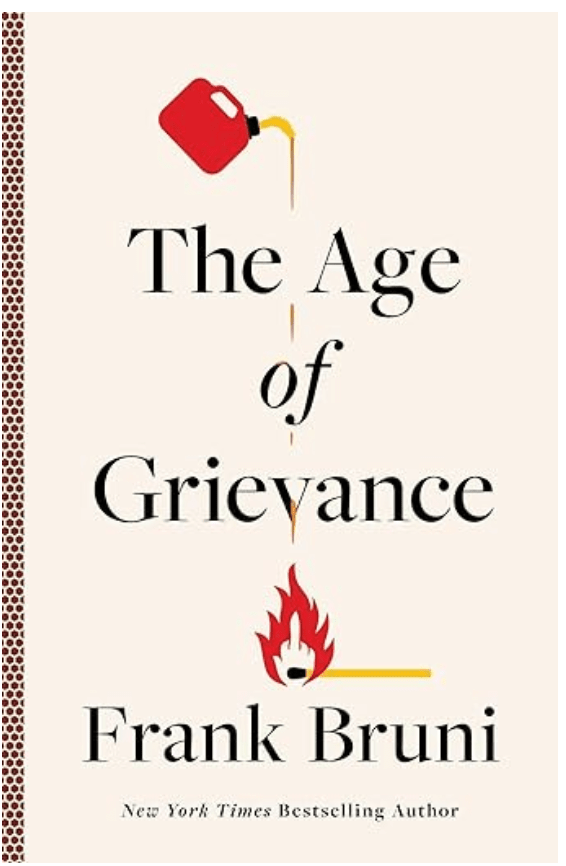
The Age of Grievance
by Frank Bruni
2024 – Simon & Schuster – 288 pages
DAVE’S SUMMARY:
In the book “The Age of Grievance,” New York Times columnist Frank Bruni explores how grievance has become a defining feature of American politics and society. He argues that grievance, fueled by a sense of victimhood and injustice, has become a destructive force that dominates public discourse. This culture of grievance cuts across political divides, with both the left and right indulging in a “blame game” that simplifies complex issues and stokes anger among their followers.
Bruni traces the roots of this phenomenon to America’s founding, noting that the nation itself was born out of legitimate grievances against British rule. However, he observes that over time, the concept of grievance has been manipulated and amplified, especially in recent decades. He points to the rise of figures like Donald Trump, who skillfully tapped into the grievances of his supporters by portraying himself as both a victim and a savior. Trump’s rhetoric, which Bruni describes as “grudge made flesh,” resonated with many Americans who felt disrespected and overlooked, leading to a surge in populist anger.
Bruni also examines how this culture of grievance has manifested on the left, with increasing calls for social justice sometimes veering into absolutism and intolerance for differing viewpoints. He critiques the tendency to frame every issue in terms of oppression and victimhood, noting that this has led to a divisive and often counterproductive discourse.
Throughout the book, Bruni underscores the dangers of allowing grievance to dominate politics. He warns that as Americans increasingly view themselves and others through the lens of grievance, they become more polarized, more distrustful of institutions, and more willing to embrace extreme measures. Bruni concludes by calling for a re-examination of how grievances are expressed and addressed, urging a return to a more constructive and empathetic approach to public discourse.
FIVE TAKEAWAYS:
1. Grievance as a Unifying Force: Bruni discusses how grievance has become a primary driver of political discourse, with both sides of the political spectrum using it to rally support by appealing to feelings of victimhood and injustice.
2. Trump’s Exploitation of Grievance: Bruni highlights how Donald Trump skillfully portrayed himself as both a victim and a savior, resonating with many Americans who felt disrespected and overlooked, and turning their grievances into political capital.
3. Historical Context of Grievance: The book traces the roots of grievance to America’s founding, noting that while it was once a legitimate force for change, it has been increasingly manipulated to serve divisive and destructive ends.
4. Polarization and Partisan Warfare: Bruni examines how the culture of grievance has exacerbated political polarization, leading to an environment where both sides view each other as existential threats, further eroding trust in democratic institutions.
5. The Impact on Social Justice: On the left, Bruni critiques the absolutism in social justice movements, where the insistence on framing every issue in terms of oppression can lead to divisive and counterproductive outcomes.
“The Age of Grievance” argues there is a need to move beyond a culture dominated by grievance and victimhood. Bruni argues that while grievances can be legitimate and a catalyst for change, when they become the primary lens through which people view the world, they lead to polarization, distrust, and the erosion of democratic institutions. To create a more constructive and empathetic society, there must be a shift towards addressing grievances in a way that promotes dialogue, understanding, and tangible improvements, rather than deepening divisions.
MY FAVORITE HIGHLIGHTS:
“What the left sees in the right and what the right sees in the left are almost the same: a bullying force intent on imposing its out-of-touch, out-of-whack values on unbelievers and on crushing them if they persist in their heresy. What the left feels and what the right feels are identical: oppressed. There’s a perverse mirror-image tidiness to it, a nasty reciprocity, even a strange symbiosis.”
“Most Americans don’t simply feel frustrated by those who disagree with them politically. They feel diminished, besieged, and imperiled by them.”
“James Kimmel Jr., a lecturer in psychiatry at the Yale University School of Medicine and the founder and codirector of the Yale Collaborative for Motive Control Studies, sees it as a kind of drug. “I’ve been researching the way grievances affect the brain,” he wrote in Politico in 2020, “and it turns out that your brain on grievance looks a lot like your brain on drugs. In fact, brain imaging studies show that harboring a grievance (a perceived wrong or injustice, real or imagined) activates the same neural reward circuitry as narcotics.”
Purchase the items here and I will receive a small commission at no extra cost to you. But, by doing this, you help support my reading habit! Thanks.
 Dave Edwards Media