Dave’s Summary:
The President’s Book of Secrets: The Untold Story of Intelligence Briefings To America’s Presidents from Kennedy to Obama
by David Priest
2016 – Public Affairs – 400 pages
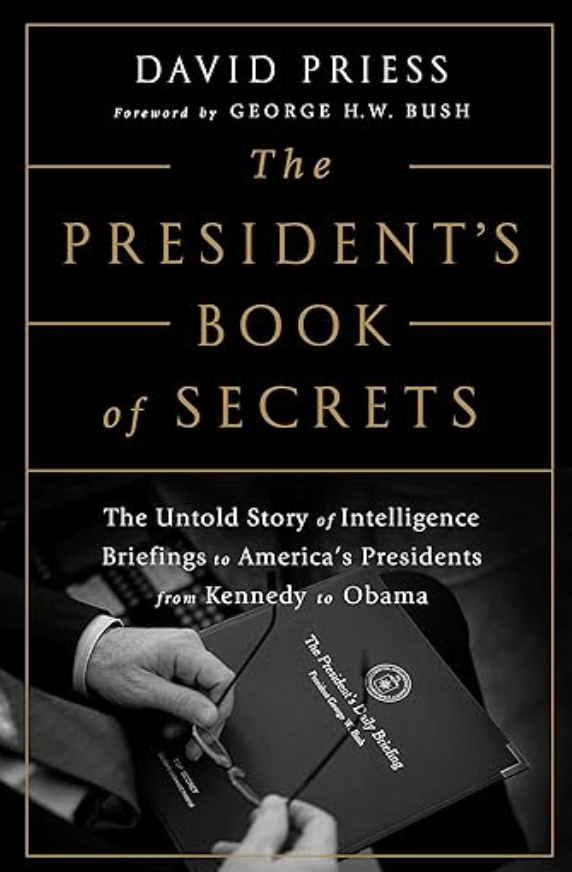
“The President’s Book of Secrets: The Untold Story of Intelligence Briefings to American Presidents” by David Priess is a fascinating behind-the-scenes book that chronicles the evolution of intelligence briefings for U.S. Presidents. Drawing from extensive interviews with over one hundred former senior U.S. policymakers and intelligence officials, Priess shares the intricate dynamics between the intelligence community and the highest echelons of political power.
Highlights:
1. Evolution of Intelligence Briefings:
o The introduction of the all-source Current Intelligence Bulletin marked a pivotal shift, incorporating analytic commentary and assessments from CIA experts, offering a deeper understanding for presidents.
2. Kennedy’s Unique Approach:
o President John F. Kennedy’s informal approach to national security decision-making is explored in detail, emphasizing his preference for crisp and insightful prose.
o The creation of the President’s Intelligence Checklist came from Kennedy’s brief background in journalism, reflecting his desire for portable, concise information.
3. Cuban Missile Crisis and Checklists:
o The book delves into the harrowing days of the Cuban Missile Crisis, emphasizing how the President’s Intelligence Checklist played a crucial role in providing real-time information to Kennedy.
o The evolution of the Checklist into the President’s Daily Brief (PDB) continued to have significance under President Lyndon Johnson.
4. Nixon’s Distrust and Lack of Mention:
o The narrative provides a nuanced exploration of President Richard Nixon’s deep-seated distrust of the CIA, portraying it as a longstanding grudge rooted in perceived political opposition.
o The absence of concrete evidence regarding Nixon’s attention to the President’s Daily Brief is presented, leaving room for speculation on the extent of his engagement.
5. Diligence of President Ford:
o President Gerald Ford’s diligent engagement with national security briefings upon assuming the presidency is highlighted, shedding light on his conscientious approach to absorbing information.
6. Carter’s Quick Study:
o President Jimmy Carter’s “terribly interested” demeanor in intelligence products is detailed, emphasizing his quick study ability and photographic memory.
o The book captures Carter’s proactive engagement with the intelligence community, portraying him as an active participant in discussions.
7. Reagan’s Evolving Briefings:
o The evolution of briefings under President Ronald Reagan is explored, with the introduction of the Defense Intelligence Supplement addressing military issues, reflecting the changing geopolitical landscape.
8. Close Relationship with PDB:
o President George H. W. Bush’s intimate relationship with his daily intelligence report is further detailed, showcasing the depth of his engagement and understanding of the intelligence landscape.
9. Clinton’s Detailed Involvement:
o The book sheds light on President Bill Clinton’s detailed involvement in intelligence briefings, revealing his inclination to expand the range of issues covered in the PDB.
o Clinton’s unique approach, including attaching magazine articles to the PDB, adds a layer of personalization and depth to his engagement with intelligence.
10. Bush’s PDB and 9/11 Warning:
o The book tells of the critical nature of the President’s Daily Brief during President George W. Bush’s tenure, emphasizing the historical significance of the August 6, 2001, PDB article warning about Bin Laden’s determination to strike in the U.S.
o The book portrays the heightened state of alert and numerous warnings provided to Bush, setting the stage for the tragic events of 9/11.
David Priess’s “The President’s Book of Secrets” provides a fascinating account of the evolution of intelligence briefings and delves into the personalities and decisions that have shaped U.S. national security policies. The details and perspectives drawn from extensive interviews make this book a comprehensive and insightful exploration of the intersection between intelligence and presidential governance throughout history. Anyone interested in the behind-the-scenes of American politics, the presidents, and US intelligence will find this to be an informative book.
Purchase the book here and I will receive a small commission without adding any cost to you. Thanks.
 Dave Edwards Media